Iconography
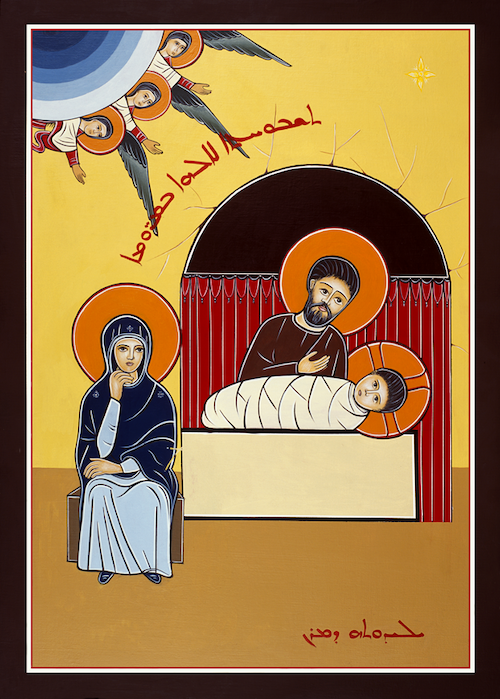
This Rabbulian icon is unique in its iconographical type. The Blessed Virgin is seated with her hand on her chin, thinking and meditating on this great event; the miraculous birth which begins the history of salvation.
She is modeled on Clio the muse of History in Greek mythology. Near her, lays the wrapped child in a manger in the form of an altar and tomb. He is born to be sacrificed and to die for us. The Just Joseph is respectfully inclining behind the manger. The grotto and the veil remind us of the grotto of Bethlehem in its realistic form. The angels trans-pierce the celestial circle singing in Syriac "Glory to God in the highest."
Bible
"Joseph also went from the town of Nazareth in Galilee to Judea, to the city of David called Bethlehem, because he was descended from the house and family of David. He went to be registered with Mary, to whom he was betrothed and who was expecting a child. While they were there, the time came for her to deliver her child. And she gave birth to her firstborn son and wrapped him in bands of cloth, and laid him in a manger, because there was no place for them in the inn." (Lk 2: 4-7)
Liturgy
"Where do we look for you? Among the luminous legions or wrapped and placed in the manger with the poor? Glory to the Invisible One, who by his love, wanted to reveal himself. He became incarnate, was one of us, and similar to us. The Father, Son and Holy Spirit are praised and glorified by the angels and the shepherds who have seen his glory." (Boouto, Nativity, Beit Gazo B.L. 14,701)