Iconography
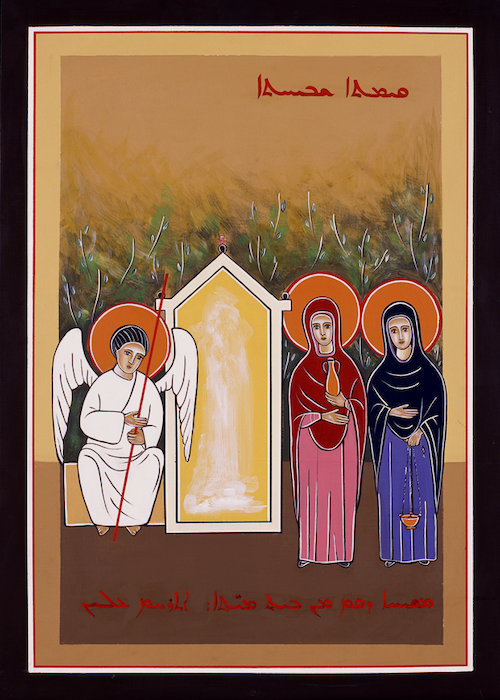
The most ancient icon of the Resurrection is the one which represents the empty luminous tomb with the Myrrhophores and the angel dressed in white. We adopted this seeing its in light of realism. Whereas the descent to hell is much later and was used in the Syriac tradition after the 13th c.
Bible
"After the Sabbath, as the first day of the week was dawning, Mary Magdalene and the other Mary went to see the tomb. And suddenly there was a great earthquake; for an angel of the Lord, descending from heaven, came and rolled back the stone and sat on it. His appearance was like lightning, and his clothing white as snow... But the angel said to the women, 'Do not be afraid; I know that you are looking for Jesus who was crucified. He is not here; for he has been raised, as he said. Come, see the place where he lay." (Mt 28: 1-3, 5-6)
Liturgy
"On Sunday, the angels, dressed in white, descended and surrounded the holy sepulcher where the Lord of All slept. They said to the holy women who came to embalm his body: he is not here, he is risen in glory. Go and tell his Apostles to go before him to Galilee." (Toubayk iidto, Resurrection, Beit Gazo, B.L. 14,703)